

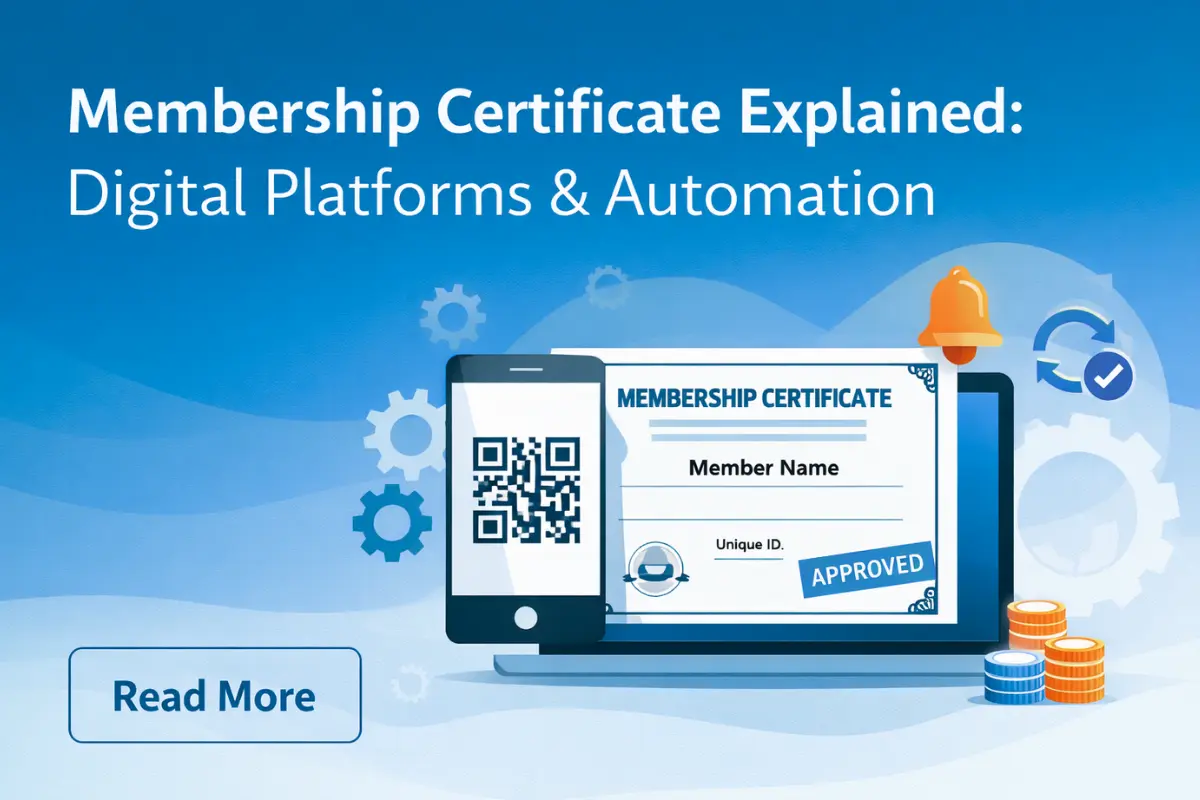
Membership Certificate Explained: Digital Platforms & Automation
Discover how membership certificates verify affiliation, eligibility, and benefits. Learn how digital platforms like Gradnet automate issuance, renewals, and verification for reliable, scalable management.

Pabel Khan
Digital Marketer
A membership certificate is an official document that confirms a person’s affiliation, status, and privileges within an organization.
It verifies eligibility for benefits, events, voting, or institutional recognition. Digital platforms simplify certificate management by automating issuance, tracking renewals, and providing verification links or QR codes.
For mid-to-large organizations, platfroms like Gradnet ensure certificates are always accurate, up-to-date, and verifiable.
Using a digital system reduces administrative errors, improves operational efficiency, and maintains member trust, making membership-certificate management reliable and scalable across professional associations, alumni networks, and clubs.
What Is a Membership Certificate?
A membership certificate is an official document that proves a person belongs to an organization.
It confirms their membership status, validity period, and sometimes their rights, such as voting or access to benefits. In practice, it is used for verification, compliance, and trust.
A simple decision framework: issue certificates only if membership status is clearly tracked and regularly updated.
A common mistake is generating certificates manually without linking them to renewal data.
Why Organizations Issue Membership Certificates?
Organizations issue membership certificates to provide formal proof of active membership, eligibility, and compliance status. In practice, they are operational tools, not decorative documents.
Proof of Membership and Verification
A membership certificate confirms that dues are paid and status is active. Members use it for employer verification, visa applications, or institutional recognition.
According to industry insights from ASAE data integrity and member validation remain top operational concerns for associations. Certificates standardize verification and reduce repeated manual confirmation requests.
Governance and Eligibility Control
In professional bodies and alumni associations, voting rights and leadership eligibility depend on accurate membership status.
A common mistake is issuing certificates manually without linking them to renewal data.
The real-world constraint is simple when records live in spreadsheets. Certificates quickly become outdated and create governance risks.
Decision framework:
If membership status affects voting, compliance, reporting, or financial accountability, structured certification is necessary.
Access to Benefits and Institutional Trust
Certificates also unlock partner discounts, event access, and professional credibility. Manual PDFs are easy to design but difficult to audit and scale.
If your organization manages hundreds or thousands of members and needs certification tied directly to renewal and payment data, consider exploring how Gradnet supports automated, status-based membership certificate workflows.
Common Types of Membership Certificates
Organizations typically issue several common types of membership certificates, each serving a specific operational purpose: active membership, lifetime membership, honorary membership, and provisional or student membership.
The type depends on eligibility rules, renewal cycles, and governance requirements.
Active Membership Certificates
This is the most common type. It confirms that dues are paid and the member is in good standing for a fixed period, usually one year.
Active certificates are often required for voting, event access, or employer verification. A common mistake is issuing them without linking expiration dates to renewal data, which creates outdated certificates and compliance gaps.
Lifetime Membership Certificates
Lifetime certificates are issued to members who make a one-time payment or receive permanent status.
Lifetime certificates reduce annual processing, and organizations lose the ability to periodically verify eligibility. In practice, this can create governance risks if roles or privileges change over time.
Honorary Membership Certificates
These certificates recognize contributions rather than paid membership. They are common in alumni networks and professional bodies.
If honorary members have limited rights (e.g., no voting), the certificate must explicitly indicate that to prevent confusion.
Provisional or Student Membership Certificates
These are temporary and conditional, often based on academic status or training completion.
A clear decision framework is essential: if eligibility changes frequently, automated tracking or regular audits are needed to avoid errors.
10 Free Membership Certificate Templates
Organizations use membership certificates to confirm active status, eligibility, and participation in their programs.
Free templates help teams save time, standardize design, and ensure a professional presentation. Below are ten widely used options, with practical framing for real-world application.

1. Classic Membership Certificate
A simple, professional template for annual or active members. Best for small to medium organizations.
Decision framework: use if certificates need quick issuance without complex data tracking.
2. Modern Digital Certificate
Designed for online distribution. It is easy to share with limited printing quality. Useful for digital-first associations or student programs.
3. Honorary Membership Template
Recognizes contributions without requiring dues. A common mistake is failing to clarify voting or access rights on the certificate. Always include privileges clearly.
4. Lifetime Membership Certificate
For members with permanent status, it reduces yearly processing; periodic eligibility review may be needed for governance.
5. Student or Provisional Certificate
Temporary certificates based on academic status or probationary membership. Use automated expiration reminders to avoid outdated documents.
6. Event-Based Membership Certificate
Issued for participation in workshops or professional events. with a simple design and integration with full membership records.
7. Professional Association Template
Includes organization logo, verification code, and membership ID. Ideal for associations with external compliance or verification requirements.
8. Club or Community Membership Template
Casual design for hobby or community clubs. It prioritizes member experience, but tracks details to avoid duplicate or expired certificates.
9. Alumni Membership Certificate
Highlights graduation year, batch, and alumni benefits. Must sync with the alumni database to ensure accurate verification.
10. Customizable Editable Template
Offers flexibility to modify text, colors, or layout. A common mistake is over-customizing without maintaining clarity or compliance standards.
When choosing templates, consider organizational size, member volume, and governance needs.
Small groups may use simple PDFs, while medium-to-large networks benefit from templates linked to membership management workflows.
For organizations managing hundreds or thousands of members, using a platform like Gradnet can streamline certificate issuance, ensure accuracy, and automatically update membership status, reducing manual errors and administrative workload.
What Is The Use Cases Of Membership Certificate?
Membership certificates are more than formal documents—they are operational tools that support verification, governance, and benefits management.
Organizations use them in multiple scenarios depending on size, member volume, and compliance needs.
1. Proof of Active Membership
A core use case is confirming that a member is active and in good standing.
This is essential for voting, access to events, or employer verification. A common mistake is issuing certificates manually without syncing to membership status.
2. Compliance and Governance
Professional associations and alumni networks use certificates to enforce eligibility rules for elections, board appointments, or professional recognition.
Without centralized data, certificates can quickly become outdated. Decision frameworks should tie issuance to verified member records.
3. Event and Program Access
Certificates can grant access to workshops, seminars, or exclusive benefits. They ensure only eligible members participate. The trade-off is between temporary use and full membership integration. If certificates are detached from databases, tracking becomes cumbersome.
4. Professional or Institutional Verification
Certificates serve as proof of membership for external institutions, employers, or licensing authorities. A common mistake is a lack of verification mechanisms, like unique IDs or QR codes. Without verification, the certificate loses credibility.
5. Recognition and Engagement
Honorary or milestone certificates boost engagement and recognize contributions. The real-world constraint is clarity: the certificate must clearly state privileges to avoid confusion.
What are the Common Challenges with Membership Certificates?
Managing membership certificates can be complex, especially for mid-sized or large organizations. Some common challenges include:
- Manual Issuance Errors: Handwritten or PDF certificates often contain outdated or incorrect member information.
- Tracking Expirations: Without automated reminders, certificates can expire unnoticed, creating compliance and governance issues.
- Verification Difficulties: Employers or institutions may struggle to confirm authenticity if certificates lack unique IDs or centralized verification.
- Design vs. Accuracy Trade-Off: Attractive templates may compromise data integrity if updates are manual.
- High Volume Management: Organizations with hundreds or thousands of members face scalability issues, leading to delays and administrative burden.
Certificates should be automated, linked to verified membership data, and updated in real time.
In practice, platforms like Gradnet solve these challenges by automating certificate generation, syncing with membership status, and providing verifiable records, making it ideal for alumni networks, professional associations, and membership-driven organizations with high volume or compliance needs.
How Digital Platforms Simplify Membership Certificates?
Digital platforms streamline the creation, management, and verification of membership certificates, reducing manual errors and administrative effort.
Automated Issuance and Renewal
Platforms generate certificates automatically when a member joins, renews, or changes status. This eliminates common mistakes like outdated data or delayed issuance.
Decision framework: automate issuance for any organization with over 200 members to ensure accuracy and scalability.
Verification and Security
Modern systems provide unique IDs, QR codes, or verification links for each certificate.
Manual certificates are prone to forgery and cannot be independently verified. Digital templates may require setup time, but they dramatically increase trust and usability.
Centralized Record Management
Digital platforms store all member and certificate data in a secure database. For large organizations, this ensures real-time updates, audit trails, and quick access for reporting or compliance checks.
Workflow Integration
Platforms like Gradnet connect certificates directly to membership status, renewal cycles, and membership payment records.
This ensures certificates are always accurate, verifiable, and automatically updated. Gradnet is best for mid-to-large alumni networks and professional associations where governance, operational efficiency, and member trust are critical.
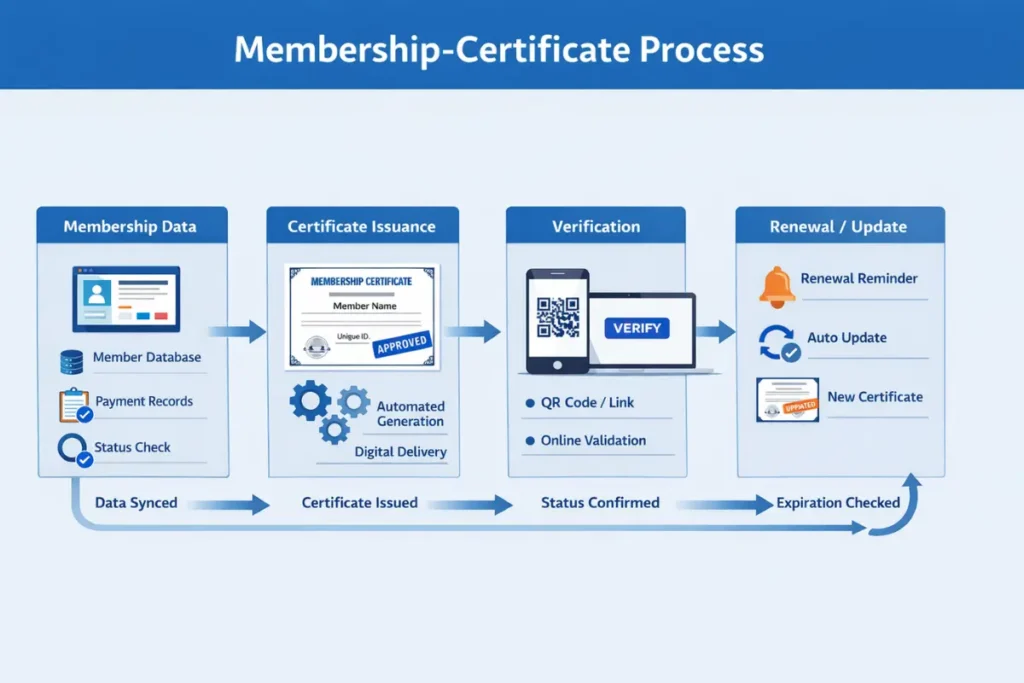
By adopting digital platforms, organizations reduce administrative burden, avoid compliance issues, and provide members with reliable, professional proof of affiliation.
Final Words
A membership-certificate ensures members are recognized, verified, and granted appropriate rights and benefits. Proper issuance reduces administrative errors, supports governance, and builds trust with institutions and members.
Organizations managing large or mid-sized membership bases face challenges like manual tracking, expired certificates, and verification delays. Using efficient tools streamlines these processes, ensuring certificates are always accurate and up-to-date.
To simplify membership management, maintain compliance, and automate certificate issuance, explore platforms like Gradnet.
To learn more about Gradnet features, or compare it with other membership management tools to optimize your certificate workflows today.
FAQ
How Long Is A Membership-Certificate Valid?
The validity depends on membership type. Annual memberships expire after one year, lifetime memberships have no expiry, and provisional or student certificates may have conditional validity.
How Is A Membership-Certificate Verified?
Certificates can be verified using unique IDs, QR codes, or online member portals. Verification ensures authenticity and prevents forgery or misuse.
Can Membership-Certificate Be Customized?
Yes, templates can include logos, colors, membership type, and signatures. Over-customization should be avoided to maintain clarity and compliance.
Are Digital Membership Certificates Legally Valid?
Yes, in most cases digital certificates are accepted, especially when issued by recognized organizations and backed by secure verification methods.
How Are Provisional Or Student Membership Certificates Used?
They provide temporary proof of membership for eligibility verification, events, or programs, often expiring automatically after graduation or probation completion.
A Smarter Way to Build Community
Gradnet centralizes everything—members, events, and fundraising—so your community can grow effortlessly.