


Alumni Engagement Strategies: How to Build a Community That Also Raises Money

Tasnova Chowdhury
Tasnova Chowdhury is a Business Analyst & Content Writer at Technext and Product Marketer for Gradnet, with 3+ years of content writing experience and a background in Computer Science and Engineering. Drawing from her research into alumni engagement, fundraising, and membership retention, she writes practical guides on alumni events, mentorship programs, and community platforms for educational institutions.
Most alumni offices split their work into two teams. One plans reunions, updates the directory, and sends the newsletter. The other writes appeals, tracks gifts, and follows up with donors. On paper that division makes sense. In practice, alumni can tell when they’re being managed by two different departments that don’t talk to each other.
Good alumni engagement strategies don’t treat giving as a separate task at all. Donations tend to follow naturally from alumni who already feel like part of something — the ones mentoring a junior, showing up to the reunion, or getting a job lead through an old classmate. Get that part right, and the “how do we get alumni to donate” problem gets a lot smaller on its own.
This guide walks through what that actually looks like day-to-day: the parts of a strong engagement program, how they feed into fundraising without anyone forcing it, and a rough starting point if you’re building this from scratch.
In this guide, you’ll find:
- The 5 pillars of a modern alumni engagement strategy (directory, events, mentoring, job board, voting)
- How everyday engagement quietly builds a stronger donor pipeline than fundraising campaigns alone
- Real numbers from alumni communities running engagement and fundraising as one system
- A simple, 5-step framework to start building this if you’re beginning from scratch
Why Alumni Engagement Matters More Than the Fundraising Pitch
Advancement teams have spent years trying to fix declining participation with better letters and smarter segmentation. Some of that helps. But alumni haven’t lost interest in their schools — they’ve just gotten pickier about where they put their time and money.
Ask any development officer which alumni give first when a campaign launches, and they’ll usually name the same people: the ones already showing up. The mentor. The one who never misses homecoming. The person who found their current job through the alumni network. That pattern isn’t just anecdotal — CASE’s ongoing alumni engagement research has found that alumni who volunteer are consistently more likely to give than those who don’t. Those relationships build trust before anyone asks for a dollar, which is the opposite of how a cold appeal works.
So the more useful question isn’t “how do we ask better?” It’s “what are we giving alumni to stay involved with in the first place?” When there’s a real answer to that, fundraising stops being a once-a-year push and turns into the next step in a relationship that was already going somewhere.
The Core Pieces of Alumni Engagement Strategy
There isn’t one program that covers this. It’s a handful of touchpoints working together, and most of the alumni engagement best practices worth following come down to getting these five right rather than adding a sixth.
A Directory Alumni Actually Use
You can’t engage someone you can’t find, and a messy or outdated directory quietly undermines everything else on this list. A few things separate a directory people open from one that gathers dust:
- Individual profiles that alumni update themselves, rather than a spreadsheet your team re-keys by hand
- Filtering by degree, industry, or location, so people can actually find someone worth reaching out to
- A map view showing where alumni are clustered, handy when you’re planning a regional meetup
- Tags — mentor, donor, board member, volunteer — so your team knows at a glance who’s active and how
Think of the directory less as a contact list and more as the shared spine the rest of your program runs on. It’s where you’d look to fill event seats, match a mentor, or figure out who to call first for a gift.
Events People Actually Want to Attend
Reunions and alumni gatherings are still one of the strongest engagement tools schools have — alumni show up for them in a way they rarely do for an email. But the value gets lost fast if the logistics are a mess.
What tends to matter most in practice:
- Ticketing built for different budgets, not one flat price for everyone
- A dedicated page per event instead of buried details in a group email
- Attendee tracking that updates on its own, so nobody’s reconciling a spreadsheet the week before
- Basic analytics afterward, so next year’s event is better than this one
An attendance list is also a fundraising list in disguise. The people who showed up are, almost by definition, your warmest prospects for whatever comes next.
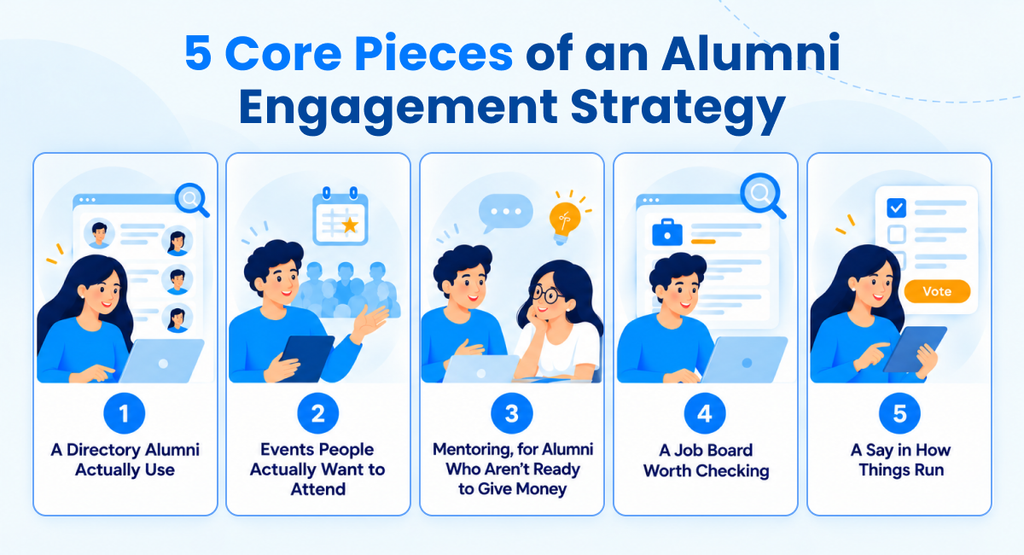
Mentoring, for Alumni Who Aren’t Ready to Give Money
Plenty of alumni have nothing to spare financially but plenty of experience to offer. A mentoring program is how you use that.
A version worth running has:
- Matching based on field or goals, so mentees aren’t cold-messaging strangers
- A defined topic or purpose, so both sides know what they’re actually doing
- No forced platform lock-in — let people talk however’s easiest for them
- Light tracking, mostly so relationships don’t quietly fizzle without anyone noticing
There’s a fundraising angle here too, even though it doesn’t look like one. An alum who mentors feels needed by their school, not just asked by it. That distinction matters more than most campaigns give it credit for.
A Job Board Worth Checking
An alumni-only job board gives graduates — especially younger ones who can’t write a check yet — a genuinely useful reason to stay logged in.
The parts worth getting right:
- Listings tied to real alumni, which carries more trust than a generic job site
- A simple application process, ideally without sending candidates off to build a resume elsewhere
- Something in it for employers too — access to a pool they already trust
Of everything on this list, a job board is the easiest one to point to and say “this actually helped me.” That kind of goodwill is hard to manufacture with a newsletter.
A Say in How Things Run
Alumni who get to vote on their board or on major decisions feel a different level of ownership than alumni who just receive updates. Online voting should be:
- Accessible remotely — no one should have to be on campus to vote
- Anonymous when it needs to be
- Secure enough that people trust the results
- Fast, with results announced quickly instead of weeks later
Elections are also a cheap way to boost participation numbers. Someone who votes for their class rep this year is a decent bet to show up at the reunion next year.
This isn’t hypothetical — associations like the CEP Alumni SUST, Architecture SUST Alumni Association (ASAA), CSE Alumni Association SUST, and the Mirzapur Ex-Cadets’ Association of North America (MECANA) have run their elections through Gradnet’s online voting module, moving what used to be a logistically painful, often disputed process onto something remote, auditable, and fast.
How Alumni Engagement Strategies Quietly Turn Into a Donor Pipeline
None of the five things above need to be run with fundraising in mind, and that’s part of why they end up working so well for it. When directory, events, mentoring, job board, and voting activity all sit in the same system, a few things happen without much extra effort:
Your team can actually see who’s engaged. Someone who mentors two other alumni or students a year and never misses a reunion is a better prospect than someone who gave once three years ago and disappeared — even though the mentor has never donated. Activity data tells you more than giving history alone.
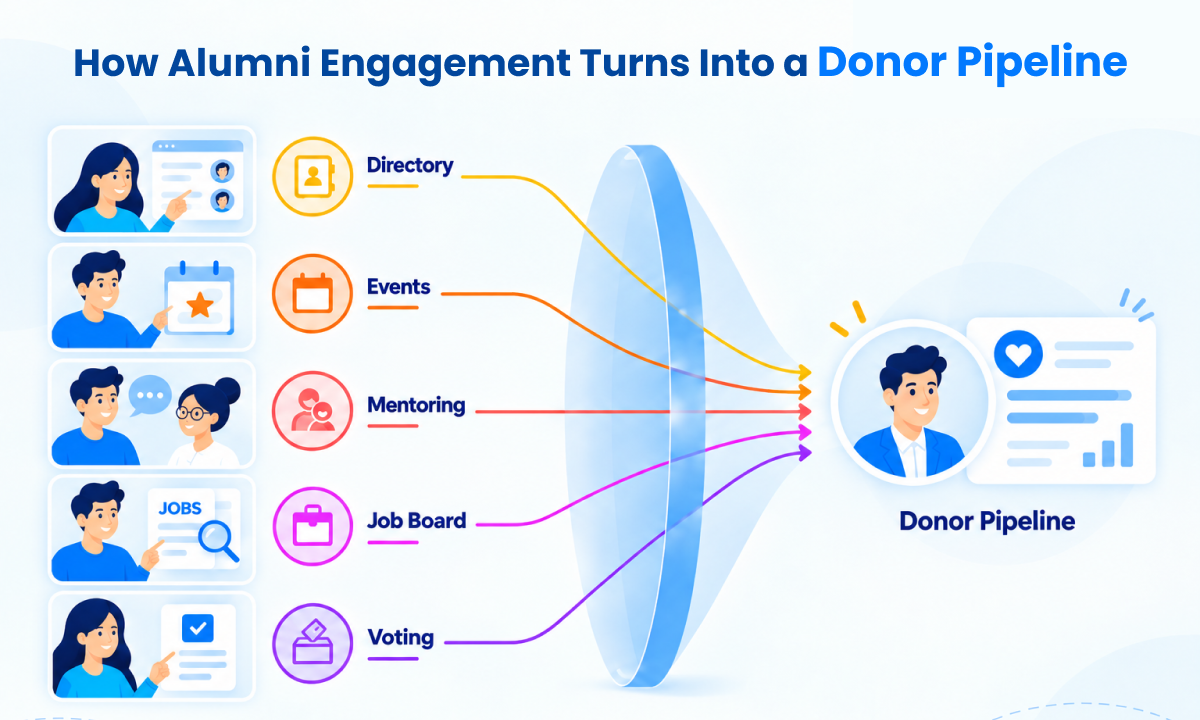
Small gifts add up faster when the relationship already exists. Alumni who are already active tend to give more readily, even in modest amounts, because there’s no cold-start problem. And an association with strong alumni participation tends to look more credible to bigger donors and outside funders watching from the sidelines.
Giving starts to feel less like an obligation. When the engagement side is genuinely working, an appeal doesn’t read as “the association again.” It reads more like “of course, I’m in.” That shift is really the whole point.
Running engagement and fundraising through five disconnected tools also costs more than most institutions notice — not just in software fees, but in the ability to see who your best prospects actually are.
What This Looks Like in Numbers
Alumni communities running engagement and fundraising through one connected alumni engagement platform tend to see different results than those juggling separate tools for each. Across Gradnet’s network, alumni associations have collectively:
| Metric | Result |
| Funds raised | $5M+ |
| Registered members | 20,000+ |
| Tickets sold | $500K+ |
| Events created | 500+ |
| Communities on the platform | 100+ |
One good example of that mix in action: one Gradnet-powered alumni association IUT Alumni Association has processed over BDT 8 million in combined transactions to date — and fundraising, while the largest single category, still made up less than half of that total. Membership dues and event revenue, the more routine, engagement-driven activity, together outweighed it. That’s what a donor pipeline built on engagement actually looks like in practice, not just in theory.
The pattern holds elsewhere too. Viqarunnisa Alumni Australia (VAAUS) — a diaspora alumni community of 700+ registered members — has donated over $60,000 AUD to social causes, alongside running regular reunions and cultural events on the same platform. The giving didn’t come from a single high-pressure campaign; it built up over years of a community that was already showing up for each other.
A Rough Starting Point
If your program right now is a static directory, a spreadsheet, and one fundraising email a year, here’s a reasonable order to tackle this:
- Look at what you’re already running. List every tool touching alumni data — directory, events, donations, mentoring sign-ups, ballots. More than one system usually means you already can’t see the full picture.
- Get everyone into one directory. Accurate, self-updating profiles are the foundation everything else depends on.
- Pick one program to start, not all four. Events or mentoring are usually the easiest wins. Get one running well before adding the next.
- Tag activity, not just gifts. Mark who’s mentoring, attending, voting — not only who’s donated. That’s the list your next campaign should actually target.
- Let the fundraising ask come later, and to a warmer list. Instead of emailing your entire database, start with everyone who’s shown up in the last year. The response rate difference is usually not subtle.
How to Increase Alumni Engagement Without Adding More Work
Most schools, universities, or associations try to increase alumni engagement by sending more — more emails, more event invites, more asks. It rarely works, because the volume isn’t the problem. What actually moves the needle is fewer, better-connected touchpoints: one directory alumni trust, one events calendar worth checking, one mentoring program that isn’t a side project, and activity data your team can actually see. Increasing alumni engagement usually means removing friction from the five pillars above, not adding a sixth program on top of them.
Final Thoughts
Alumni engagement and alumni fundraising aren’t really two separate jobs competing for budget — they’re two stages of the same relationship. Schools that run them as one connected system, instead of a directory here and a donation form somewhere else, end up with a more active community and a healthier pipeline of donors, without doubling their workload to get there.
If you’re ready to bring your directory, events, mentoring, job board, voting, and fundraising into one place, that’s what Gradnet is built for. Once your engagement side is moving, our guides on writing fundraising letters that convert and modernizing your university’s fundraising strategy will help you turn that community into a sustainable giving program.
A Smarter Way to Build Community
Gradnet centralizes everything—members, events, and fundraising—so your community can grow effortlessly.