


How to Write a Sponsorship Letter That Gets a Yes in 2026

Tasnova Chowdhury
Tasnova Chowdhury is a Business Analyst & Content Writer at Technext and Product Marketer for Gradnet, with 3+ years of content writing experience and a background in Computer Science and Engineering. Drawing from her research into alumni engagement, fundraising, and membership retention, she writes practical guides on alumni events, mentorship programs, and community platforms for educational institutions.
Alumni associations run on ambition. Scholarships, flagship reunions, mentorship programs, community hubs — the vision is rarely the problem. Funding usually is.
Corporate sponsorships are one of the most effective ways to close that gap. But most sponsorship letters never get a response. The cause is worthy. The community is real. The letter just doesn’t speak the sponsor’s language.
If you’re responsible for alumni fundraising outreach — whether you’re an association president, a community manager, or a development officer — this guide walks you through exactly how to write a sponsorship letter that gets read, considered, and answered with a yes. There’s a ready-to-use template included.
A note on scope: this guide is written primarily for alumni associations, but the framework applies equally to any community-based organisation — professional associations, nonprofit groups, sports clubs, faith communities, or cultural bodies.
Wherever you manage a community and need outside funding to support it, the principles here are the same. Swap “alumni” for your community type and everything still holds.
Why Your Sponsorship Request Letter Isn’t Getting Replies
Before getting into structure, it helps to understand why most letters fail. The patterns are predictable:
- Too vague. “We’d love your support” tells a sponsor nothing about what they’ll receive in return.
- One-size-fits-all. Mass-sending the same corporate sponsorship request letter to 50 companies signals you haven’t done your homework — and sponsors can tell immediately.
- Focused entirely on need. Sponsors are not charities. They’re investing in exposure, brand association, or direct community access. They want ROI — and with event sponsorship growing 15% in 2024, competition for sponsor attention has never been higher.
- No clear ask. Letters that never state a specific amount or tier waste everyone’s time, including yours.
- Poor timing. Reaching out a week before your event is too late. Sponsorship decisions — especially at the corporate level — often take weeks.
Now let’s fix all of that.
How to Write a Sponsorship Letter: A Step-by-Step Guide
Understanding why letters fail is only half the battle. The other half is knowing exactly what to do instead — and doing it in the right order. The five steps below give you a repeatable process you can apply to every sponsorship pitch, whether you’re writing to a local business or a national corporation. Work through them in sequence before you send a single word.
Step 1: Research Before You Write a Single Word
The most effective sponsorship letters are written for one specific company — not a generic prospect list.
Before you open a blank document, answer three questions:
Question 1: Who are you writing to?
Find the right contact. For community partnership letters, the best bet is usually a marketing manager, CSR (Corporate Social Responsibility) lead, or business development officer. A letter sent to a generic inbox has half the chance.
Question 2: What does this sponsor actually care about?
A regional bank wants community trust and local brand presence. A tech company might want access to engineering alumni. A law firm may value the professional network and speaking opportunities. Study their recent sponsorships, social media, and CSR reports before you write.
Question 3: What can you genuinely offer them?
Your alumni network is more valuable than you think — but you need to articulate that value in concrete terms. How many members? Which industries? What cities or countries are they located in?
Gradnet tip: Your Gradnet alumni directory gives you live data — member count, location spread, professional categories, and engagement stats. “Our network includes 4,200 alumni across 28 countries, active in finance, engineering, and healthcare” is far more compelling than “we have a large global community.” Sponsors fund what they can measure.
Book a free demo to see exactly what audience data you can present →
Step 2: Build Your Sponsorship Tiers Before Writing the Letter
Here’s a mistake that quietly kills credibility: writing a corporate sponsorship request letter that says “various tiers are available” without defining what those tiers actually include.
Before drafting anything, structure your sponsorship offering — 3 to 4 levels, what each includes, and what you’ll charge for each.
And don’t underestimate the names. A “Gold Sponsor” and a “Founder’s Circle Sponsor” may offer identical benefits — but the second commands more prestige, higher commitment, and is far more likely to renew. We’ve covered this in depth in our guide on sponsorship level names that boost event engagement — it’s worth reading before you finalize your structure.
Once your tiers exist, your letter becomes a cover document for a complete, well-built offer. Sponsors can feel the difference between a letter that’s backed by real planning versus one that’s making it up as it goes.
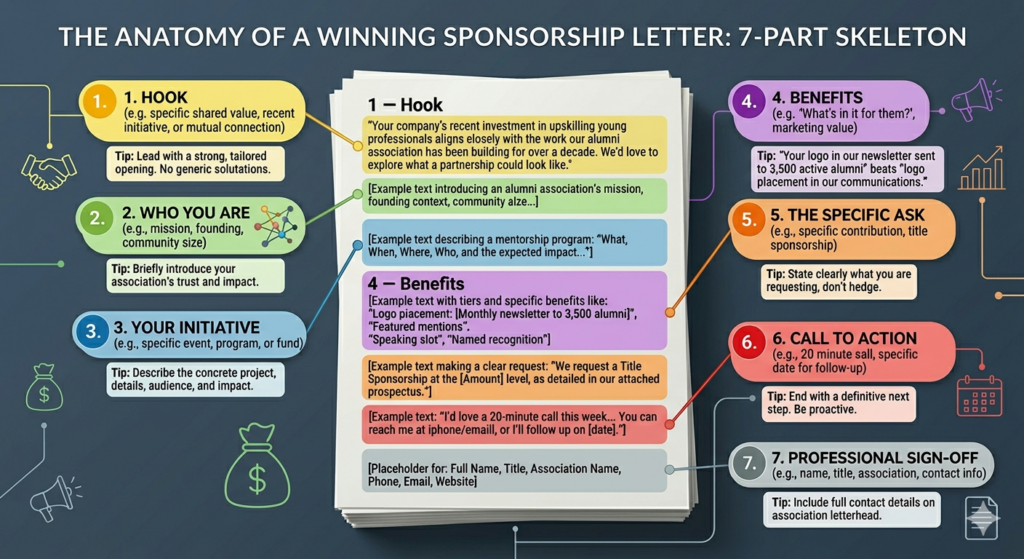
Step 3: How to Structure a Sponsorship Letter — Section by Section
A strong sponsorship proposal letter follows a clear framework. Here’s how to build it:
Opening hook (1–2 sentences)
Skip “Dear Sir/Madam, we are pleased to write to you.” That goes straight to the bin.
Open with something specific — a shared value, a recent initiative of theirs, or a mutual connection.
Example:
“Your company’s recent investment in upskilling young professionals aligns closely with the work our alumni association has been building for over a decade. We’d love to explore what a partnership could look like.”
Who you are (1 short paragraph)
Introduce your association — its mission, founding context, and community size. Keep it brief. Sponsors need enough to trust you, not your full history.
What you need support for (1–2 paragraphs)
Describe the specific initiative clearly. Whether it’s a sponsorship letter for an alumni event, a scholarship fund, or a mentorship program — be concrete:
- What is it?
- When and where?
- Who participates, and how many?
- What impact will it create?
Vague programs don’t get funded. Specific ones do.
What the sponsor gets — the section that decides everything
This is where most letters fall apart. You must answer the unspoken question in every sponsor’s mind: “What’s in it for us?”
Lay out your tiers and what each includes. Common event sponsorship benefits:
- Logo placement on event materials, banners, and the alumni website
- Featured mentions in email newsletters (include your subscriber count)
- Speaking slot or exhibition booth at the event
- Social media recognition (include your follower counts)
- Named recognition in event programs — “Platinum Partner: [Company Name]”
- Direct address to the alumni community
Specificity wins. “Your logo will appear in our monthly newsletter sent to 3,500 active alumni” is worth ten times more than “logo placement in our communications.”
The specific ask
State clearly what you’re requesting. Don’t hedge. If you want a Title Sponsorship at a specific contribution level, say so. If you’re presenting multiple tiers, reference them briefly and attach your full sponsorship prospectus.
The call to action
End with a clear next step — not an open-ended “we look forward to hearing from you.”
Example:
“I’d love a 20-minute call this week to walk you through our full sponsorship prospectus. You can reach me at [phone/email], or I’ll follow up on [specific date] if I haven’t heard from you.”
Professional sign-off
Full name, title, association name, phone, email, website. Use the association letterhead if you have it.
Step 4: Tailor Your Pitch for Different Sponsor Types
The structure stays the same — but your emphasis should shift based on who you’re writing to.
Local businesses — Lead with community presence and brand goodwill. Show them you’re rooted in the same area they serve. Alumni association partnership outreach with local businesses is often warmer and faster to close.
Large corporations — Focus on CSR alignment, scale, and data. Use concrete audience numbers. Attach a formal sponsorship prospectus with member demographics and engagement stats.
Individual alumni donors — This isn’t really a sponsorship letter; it’s a personal appeal. Lean into shared identity and the direct impact on students or the next generation.
Alumni-run businesses — Your warmest audience. Make the ask personal. Feature them as success stories within the community, not just corporate sponsors.
Government or institutional sponsors — Emphasize public benefit, scale of reach, and formal recognition. Use more structured language and detailed reporting.
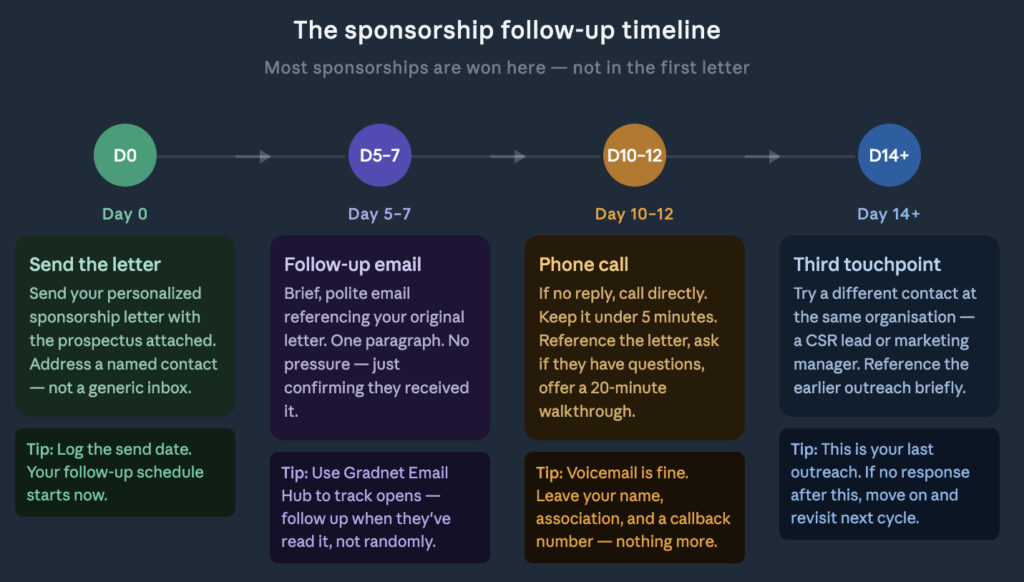
Step 5: The Sponsorship Follow-Up Email — Where Most Deals Are Actually Won
Sending the letter is only half the work. Most sponsorships are decided not in the initial outreach, but in the follow-up.
Wait 5–7 business days, then send a brief, polite follow-up email referencing your original letter. If there’s still no response, try a phone call. A third touchpoint — perhaps a different contact at the same organization — is perfectly professional.
Sponsors receive dozens of requests. Respectful persistence signals genuine commitment and sets you apart from the organizations that send one letter and go quiet.
What to Include in Your Sponsorship Prospectus
Your letter works best as a cover document. Back it up with:
- Sponsorship prospectus — 5–10 pages covering tier breakdowns, audience data, event logistics, and past highlights
- Community stats sheet — member count, demographics, engagement rates, geographic spread
- Past event highlights — attendance numbers, photos, press coverage
- Association profile — registration credentials, leadership team, mission statement
The more organized your supporting materials, the more seriously a sponsor takes your ask.
The Data Problem That Quietly Kills Sponsorship Pitches
Here’s something most alumni associations discover the hard way: a well-written letter backed by weak data loses to a decent letter backed by strong data.
Sponsors fund what they can measure. They want proof that your community is real, active, and worth the investment. The more you can quantify — member count, engagement rates, event attendance, industry breakdown — the stronger your pitch holds up under scrutiny. This is consistent with what CASE (Council for Advancement and Support of Education) — the global body setting best practices for alumni advancement — emphasizes across its fundraising guidance: structured community data is foundational to any successful outreach, sponsorship or otherwise.
This is where how you manage your alumni community has a direct impact on how to get sponsors for alumni events. When your data is organized and current, you can pull a compelling audience overview in minutes. When it’s scattered across spreadsheets and old email threads, you’re estimating — and sponsors can tell the difference.
Gradnet is built specifically for this — giving alumni associations and community managers a single source of truth for member data, event history, fundraising analytics, and engagement tracking. When you walk into a sponsorship conversation backed by live numbers, not guesses, you’re in a different conversation entirely.
Want to see what your community data could look like when it’s properly organized — ready for any sponsor pitch?
Quick Checklist Before You Send
- ✅ Addressed to a named individual, not “To Whom It May Concern”
- ✅ Personalized opening that references the sponsor specifically
- ✅ Clear initiative description with dates, scale, and expected impact
- ✅ Sponsor benefits listed by tier, specific and quantified
- ✅ Concrete ask — amount or tier stated explicitly
- ✅ Clear call to action with a follow-up date
- ✅ Professional letterhead, clean formatting, proofread
- ✅ Sponsorship prospectus or supporting materials attached
- ✅ Follow-up date already in your calendar
Final Thoughts
Writing a sponsorship letter that actually works isn’t about clever language or lengthy appeals. It’s about clarity, specificity, and a genuine understanding of what your sponsor values — not just what your association needs.
Know who you’re writing to. Define your tiers before you write — and before you finalize them, read our guide on sponsorship level names that drive real engagement for a practical framework. Make a concrete ask. Show the value exchange clearly. Follow up consistently.
Your alumni association has more to offer potential sponsors than you might realize. The right letter, written the right way, makes that case impossible to ignore.
A Smarter Way to Build Community
Gradnet centralizes everything—members, events, and fundraising—so your community can grow effortlessly.