

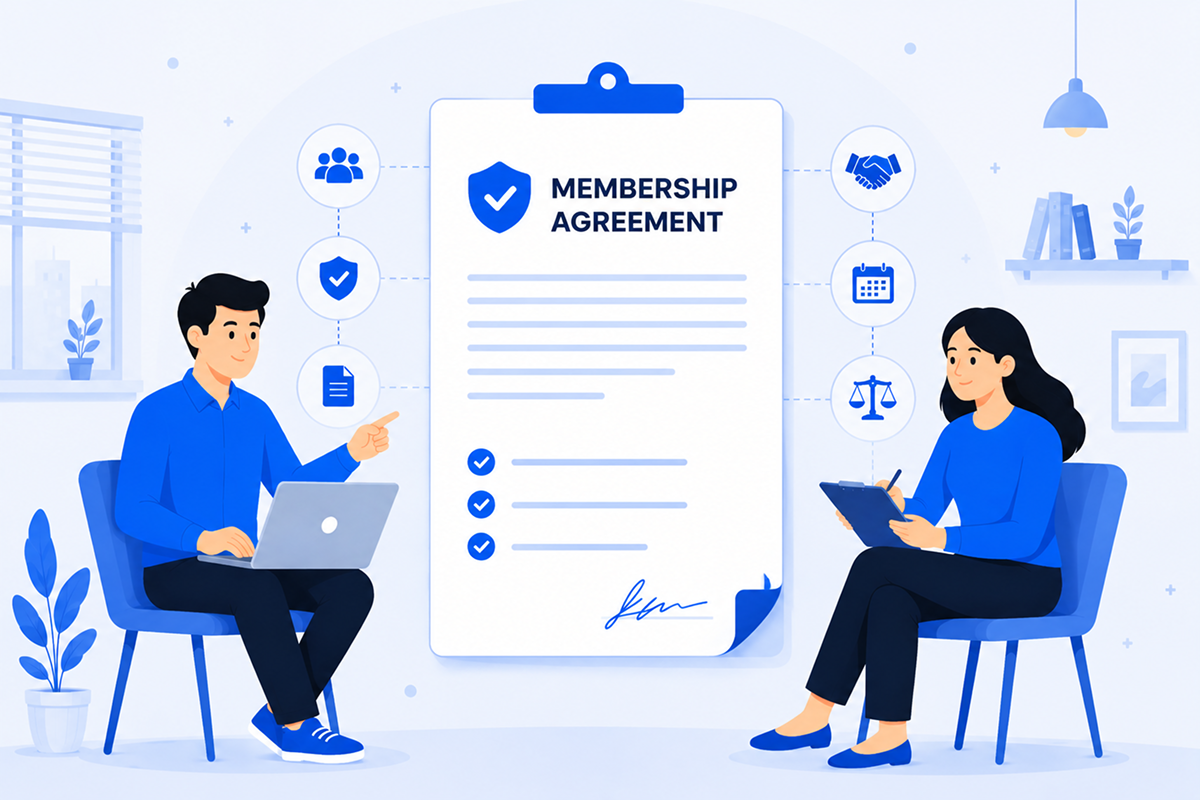
Professional Membership Agreement Template for Businesses

Pabel Khan
Digital Marketer
A membership agreement template is a ready-to-use legal document that defines the rights, duties, fees, rules, and termination terms between an organization and its members.
It helps businesses, clubs, associations, and subscription services clearly outline expectations before accepting members.
A well-written template reduces disputes, protects liability, and ensures consistent policies for payments, renewals, conduct, and cancellations.
Using a structured template saves time and ensures your agreement includes essential legal and operational clauses.
What Is a Membership Agreement Template?
A membership agreement template is a ready-to-use legal document that outlines the rules between an organization and its members.
It clearly explains who can join, how much they pay, what benefits they receive, and when membership can end.
It also defines refund terms, behavior standards, and how personal data is handled. Organizations use it to prevent disputes, protect revenue, and maintain compliance.
Instead of drafting terms from scratch, teams customize a template to match their structure, payment model, and policies.
A strong template reduces risk and ensures every member agrees to the same clear conditions before joining.

Core Clauses Every Membership Agreement Template Must Include
A strong membership agreement protects both the organization and its members. It prevents payment disputes, clarifies expectations, and reduces legal risk.
Without clear clauses, even small issues can turn into conflicts. Below are the core sections every membership agreement template should include.
1. Membership Eligibility Criteria
This clause defines who can become a member and how approval works. It prevents disputes by clearly stating requirements such as qualifications, affiliation, or age. If eligibility is unclear, rejected applicants may challenge decisions.
- Who qualifies
- Documentation required
- Approval process
If omitted, disputes arise over denied applications.
2. Fees, Payment Terms & Refund Policy
This section explains membership fees, renewal cycles, payment deadlines, and refund rules.
It should also clarify auto-renewal terms if applicable. Clear payment language reduces chargebacks and financial misunderstandings.
Clarify:
- Dues structure
- Renewal frequency
- Auto-renewal terms
- Refund rules
Without this, chargebacks and disputes increase.
3. Member Responsibilities and Code of Conduct
It outlines expected behavior and consequences for violations. This gives the organization authority to suspend or terminate membership if needed.
Important for:
- Alumni networks
- Professional bodies
- Associations
This clause protects community standards and allows suspension for violations.
4. Data Privacy & Communication Consent
This explains what personal data is collected and how it is used. It also covers email consent and record keeping.
Specify:
- What data is collected
- How it is used
- Email communication consent
- Data retention policy
This is critical under international privacy regulations.
5. Termination & Suspension Rules
This defines how membership ends, whether by resignation, non-payment, or misconduct.
Define:
- Voluntary resignation
- Non-payment
- Behavioral violations
- Appeals process
Without clarity, enforcement becomes inconsistent.
6. Limitation of Liability
This protects the organization from legal claims related to events or services.
Protects the organization from:
- Event-related claims
- Third-party service issues
- Platform disruptions
This is often poorly written in generic templates.
10 Best Membership Agreement Template Types
Membership agreements help organizations and members work smoothly together. They set clear expectations, protect both sides, and make joining easier.
The right template depends on the type of group or service. Below are 10 practical membership agreement templates, each explained with simple use cases.
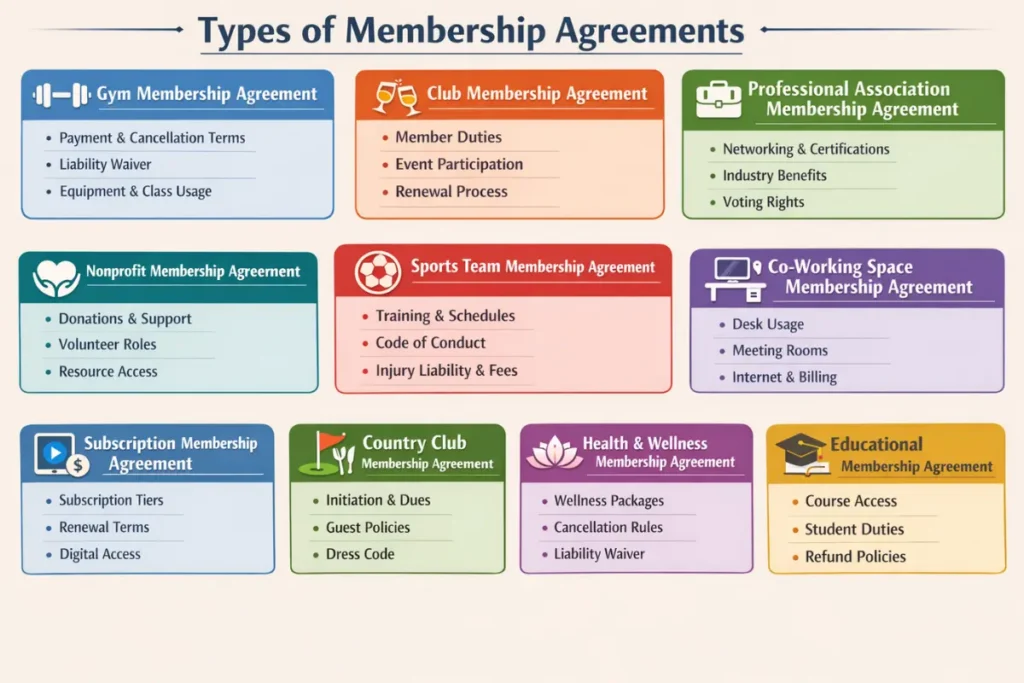
1. Gym Membership Agreement
This template is for fitness centers.
Use case: It explains payment rules, cancellation terms, liability waivers, and how members can use equipment and classes.
2. Club Membership Agreement
Made for social or hobby clubs.
Use case: It covers member duties, event participation rules, and renewal processes.
3. Professional Association Membership Agreement
Used by trade groups or industry associations.
Use case: It defines benefits like networking, certifications, and voting rights.
4. Nonprofit Membership Agreement
For charities or community organizations.
Use case: It clarifies donation expectations, volunteer commitments, and access to resources.
5. Sports Team Membership Agreement
Designed for local leagues or academies.
Use case: It covers training schedules, code of conduct, injury liability, and fees.
6. Co-Working Space Membership Agreement
For shared office spaces.
Use case: It explains desk usage, meeting room access, internet policies, and billing cycles.
7. Subscription Membership Agreement
Used by online platforms or content providers.
Use case: It details subscription tiers, renewal terms, and digital access rights.
8. Country Club Membership Agreement
For luxury clubs offering golf, tennis, or dining.
Use case: It defines initiation fees, monthly dues, guest policies, and dress codes.
9. Health & Wellness Membership Agreement
Covers spas, yoga studios, or wellness centers.
Use case: It includes package terms, cancellation rules, liability waivers, and member perks.
10. Educational Membership Agreement
For online learning platforms or private academies.
Use case: It explains course access, renewal terms, student responsibilities, and refund policies.
Where Most Membership Agreements Fail?
Many organizations create a membership agreement once and rarely review it again.
The document looks complete, but hidden gaps create legal, financial, and operational risks.
Most failures are not about missing pages. They come from unclear terms and poor management.
Vague Payment and Refund Terms
Unclear billing cycles, renewal rules, or refund conditions lead to disputes. Members may claim they did not understand auto-renewal or cancellation deadlines. Precise language prevents chargebacks and complaints.
No Clear Termination Authority
Some agreements fail to explain when and how a member can be suspended or removed. Without defined authority and process, enforcement becomes inconsistent and legally risky.
Weak Data and Consent Language
Many templates ignore detailed data usage and communication consent. This creates compliance problems, especially when handling large member databases.
Outdated or Untracked Versions
Organizations often update policies but fail to track which version a member accepted. During disputes, this creates confusion and weakens enforcement.
Manual Record Management
Storing signed agreements in scattered files or spreadsheets increases the chance of missing records during audits.
How To Manage Membership Agreements at Scale?
As membership grows, agreements become harder to manage. What works for 200 members often fails at 5,000.
The challenge is not writing the agreement. The challenge is tracking, updating, and enforcing it consistently.

Centralized Member Records
All agreements should be stored in one system. This ensures you can quickly access who signed what version and when. Scattered files increase audit risk and slow down operations.
Version Control and Policy Updates
When terms change, you must track the new version and record member acceptance. Without version control, enforcement becomes weak during disputes.
Automated Renewals and Expiry Tracking
Manual reminders fail at scale. Automated renewal notices reduce lapses and prevent revenue loss. Clear tracking also helps identify inactive members.
Consent and Data Audit Trails
Large organizations must prove when consent was given and how data is used. A structured system keeps time-stamped records and communication history.
Tier and Benefit Management
If you offer multiple membership levels, agreements must match each tier. Clear system rules prevent benefit confusion and upgrade errors.
Use a platform instead of static templates when you need scalability, collaboration, and customization.
Templates are fine for simple, one-off tasks, but platforms like Gradnet are better for organizations aiming to grow, integrate, and make smarter decisions.
When to Use a Platform Instead of Static Templates?
Choosing between a platform and static templates depends on how flexible and scalable your needs are.
Templates are quick and simple, but they often limit growth. Platforms give more control, automation, and adaptability when your organization is ready to move beyond basic solutions.
When to Use a Platform
- Dynamic Needs: If your workflows change often, a platform adapts better than fixed templates.
- Collaboration: Teams working together across departments benefit from shared access and integrations.
- Scalability: As your organization grows, platforms handle larger data, more users, and complex processes.
- Customization: Platforms allow tailored features, while templates stay rigid.
- Decision Support: Platforms can provide analytics and insights, helping leaders make informed choices.
Gradnet is a strong choice when organizations want more than static templates. It fits best for mid-sized to large teams that need structured workflows, real-time collaboration, and scalable solutions.
Its core differentiator is the ability to combine ease of use with advanced customization. Gradnet is not just a tool it’s a platform that supports decision-making and growth.
How to Choose the Right Membership Agreement Template?

Use a membership agreement template that is clear, customizable, and legally compliant.
The right choice depends on your organization type and the level of detail you need.
Avoid templates that are too generic or filled with confusing legal terms. A strong template should protect your business, set fair expectations, and make joining simple for members.
Key Decision Factors
- Clarity of Terms: Pick a template that explains rights, responsibilities, and fees in simple language. Avoid overly complex legal jargon that confuses members.
- Fit for Organization Type: A gym, co-working space, or professional association will each need slightly different agreements. Make sure the template reflects your industry.
- Flexibility: Choose a template that allows customization. You should be able to add or remove clauses depending on your policies.
- Legal Compliance: Ensure the template aligns with local laws and regulations. This prevents disputes and keeps your agreement enforceable.
- Member Experience: A clear, fair, and easy-to-read agreement builds trust and reduces friction during sign-up.
Final Thoughts
A membership agreement template helps you set clear expectations, protect your organization, and avoid legal confusion.
It ensures every member understands fees, responsibilities, benefits, and termination rules before joining.
Instead of drafting agreements from scratch each time, using a structured and editable template keeps your process consistent and professional.
As your organization grows, managing memberships manually can become complex. Platforms like Gradnet help streamline member onboarding, agreement tracking, renewals, and communication in one place.
With the right template and system in place, you can focus more on growth and the member experience rather than on paperwork and disputes.
FAQs
Is a membership agreement legally required?
Not always legally mandatory, but strongly recommended. It protects both parties and clarifies rights, fees, and termination conditions.
Can I use a free membership agreement template?
Yes, for small or informal groups. But it should be reviewed and customized to fit your legal and operational needs.
What’s The Difference Between Terms And Conditions And A Membership Agreement?
Terms and conditions are broad website rules. A membership agreement defines specific obligations between the organization and its members.
How Often Should A Membership Agreement Be Updated?
Membership agreements should be updated at least once a year. They also need revision whenever laws, fees, or organizational policies change to stay accurate.
A Smarter Way to Build Community
Gradnet centralizes everything—members, events, and fundraising—so your community can grow effortlessly.